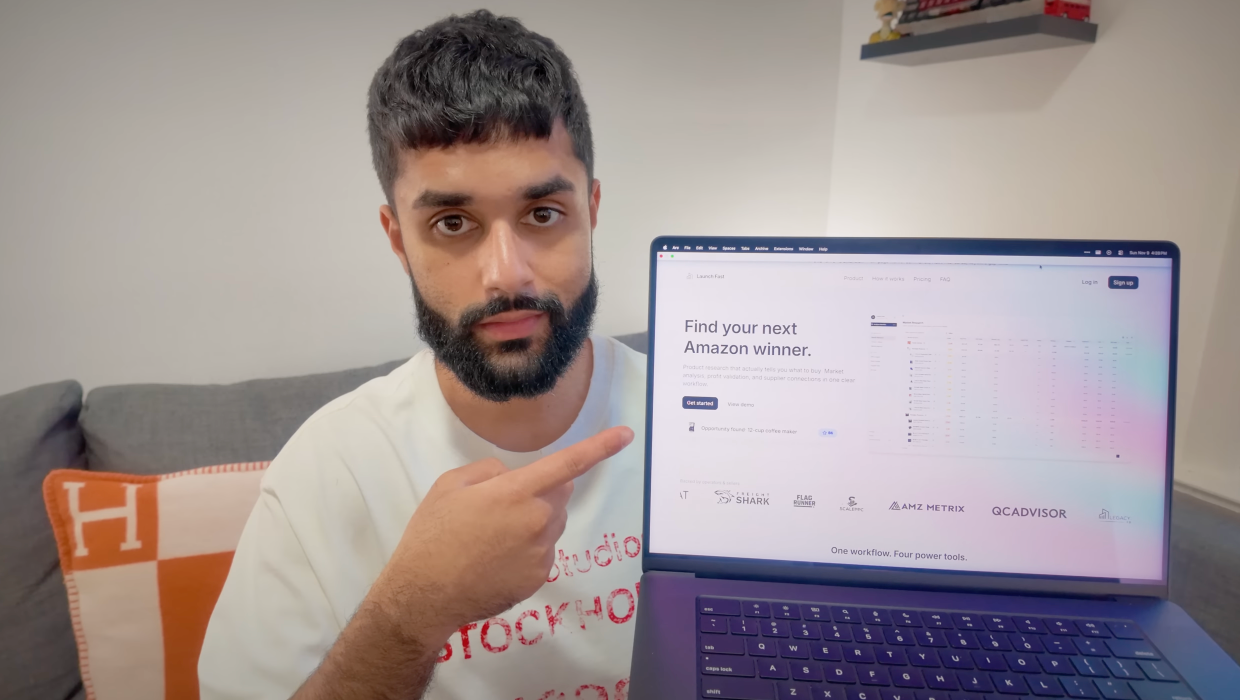
Hiring for Equity: How to Build a $20k MRR SaaS in 48 Hours
On a Friday evening, Hassam made a crazy bet with himself: build a functional app in just 48 hours.
Fast forward 90 days, and that app was generating over $21,800 in monthly revenue. The most surprising part? Hassam didn't know how to code.

His journey is a masterclass for anyone who feels stuck because they aren't a programmer, don't have a technical team, or simply don't know where to start. This is the story of how a non-technical office worker built a high-earning SaaS product in a single weekend.
Hassam’s story began like many others—balancing a day job with a side hustle. He was an Amazon seller managing two private brands. In 2023, he discovered Cursor, an AI-powered coding tool, and realized he no longer needed a computer science degree to build software.
Initially, he spiraled into a cycle of "shiny object syndrome." He tried building AI video generators, resume trackers, and a dozen other small utilities. All of them failed. Ten to twelve projects ended up in the "GitHub graveyard" before they ever saw a single user.
Through these failures, he realized his mistake: he was trying to solve other people's problems instead of his own. He stopped looking for "cool" ideas and started looking at his own daily frustrations as an Amazon seller.
He spent 20 to 30 hours on product research for every new launch, jumping between tabs and copying data into messy Excel sheets. Existing tools only solved the problem "on paper" but didn't fix the actual workflow bottleneck. He decided to build the tool he personally needed.

However, Hassam knew the "Death Trap" of independent developers: building a product that no one knows exists. Instead of spending years building a following from scratch, he came up with a genius distribution strategy.
Two years prior, Hassam had taken an Amazon seller training course called Legacy X. This community had thousands of active sellers—his exact target audience. He approached them with a bold offer: "Give me 48 hours. I will build a research tool better than anything on the market. If you like it, we partner. If not, you lose nothing."
Legacy X agreed. This was his "Equity for Distribution" strategy. He traded 50% of his future business for immediate access to thousands of customers. As he put it: "50% of something is always worth more than 100% of nothing."
The 48-hour sprint was a blur of focus. He spent the first four hours mapping out the system based on the community's specific training methods. Then, he spent the next eight hours using Cursor to build the core functionality. He didn't aim for perfection; he aimed for utility.
The rest of the weekend was spent testing, fixing bugs, and polishing the UI. By the final hours, he had a professional-looking product and a demo video ready. When the partners at Legacy X saw it, their response was immediate: "Quit your job. Let's do this full-time."

The growth was explosive. Within 30 days, the revenue hit $10,000. By day 90, it reached $21,800. He achieved this without content marketing, Facebook ads, or cold emails because he put the product directly in front of a hungry audience.
Why did this work when his previous 12 projects failed? The difference was "Domain Knowledge." Hassam didn't just write code; he understood the specific pain points of an Amazon seller better than any professional programmer could. He knew which features were essential and which were fluff.
If you want to replicate his success, the path follows six clear steps. First, identify your own domain expertise—what do you know better than most? Second, find an existing market where people are already spending money. Third, dig deep into user frustrations in that niche.
Fourth, build a Minimum Viable Product (MVP) that solves just one major problem. Fifth, find an existing distribution channel—a community, a coach, or a platform—and offer them a partnership. Finally, iterate daily based on real user feedback.
You don't need a five-year degree or a massive budget. Hassam’s tech stack was simple: Cursor for coding, Vercel for hosting, and Supabase for the database. Total cost? About $20 a month for the AI subscription.
The truth is that you aren't waiting for a better idea or more skills; you are likely just waiting for permission to start. AI has lowered the barrier to entry to almost zero. Your domain knowledge—whether it's in fitness, teaching, or design—is your most valuable asset.
Stop planning and start building. Spend this weekend turning your "painkiller" idea into a reality. After all, 48 hours might be all that stands between you and your next big breakthrough.
What is one repetitive task in your industry that everyone hates? That might just be your $20,000-a-month opportunity.